Pages

Showing posts with label Children's Mobile Library. Show all posts

Wednesday, 2 October 2013

These remind me of my UK Children's Mobile Library experiences


I apologise for the predominance of adverts in the Sylva Herald and the request to subscribe, but I felt that the link to the article is worthwhile. The Reading Rover that is featured, reminded me of some of the CMLs that I visited when I was doing the PhD, going to some outlying places, traveler camps, special schools, children's secure units, all places where it is hard for children to find books, Internet and information. 

http://www.thesylvaherald.com/news/article_93fe4866-2adc-11e3-afd1-0019bb30f31a.html

When I read the title, though,I thought that by Bogarts they meant the mythical creature, but that is spelled with two g's. 

The photograph of the children sitting on the floor in this CML reminds me of my time aboard the Reading Rocket. Although we had some seating at the back of the vehicle, when you had a class of thirty five year olds, or a batch of toddlers and their mums, it was the adults that sat on the seats, and the children spilled out all over the floor. 


I used to sit on the floor too, to read the stories, because I wanted to be on the same level as the children. It was easier for them to see the pictures in the books if I was at their height. If you read my previous post, you would realise that I am, in fact, closer to their height. I am a little concerned that the west (eg, Europe) is imposing their culture onto Thai children, but then I thought How magical it would be if a mobile library full of Thai fairy stories and books came around the UK, and I realised that reading Brothers Grimm tales would be just as exotic to Thai children as a Thai CML would be to ours. 

I am similarly concerned about the cultural ethics of this CML project, asking for donations of books in English. I really think that children's books should be published in a child's native language and traditional tales. This would boost literacy, bolster cultures and promote a local publishing industry.


Once again there is a "However ..." because in the day job I have come across many African academic web sites, and the main language appears to be English, I suppose because it is a common language between different African dialects. English is also a global academic language, so maybe it is good for Children to be learning English. On the other hand, it is just as vital that children are well educated in their native tongue. Why am I so concerned about this? Because I was brought up as an English speaking Welsh woman, and although I have the vaguest smattering of Welsh I cannot go back to my own country for a job because I am not bi-lingual.   


Tuesday, 19 February 2013

Best practices in Children's Mobile Libraries: Stock procurement

Someone has to make the decision of what to put into a children's mobile library and as can be expected, it varies according to the authority. In some library authorities the operators advised a library purchasing team about which books or items were popular and went well in their vehicles. Some purchasing teams were made up of children's librarians, but in others they were not. In some authorities, the operators had no say at all, library stock being centrally purchased from a Library wholesaler. It is perhaps no surprise to discover that the services where operators were able to advise the acquisitions teams about which books their customers liked were more successful at inspiring children to read. 

The number of requests for specific books, or even books of a certain genre, was much greater in the vehicles where the books were centrally purchased by staff who had no contact with the vehicles, staff from the vehicles, or even other children's libraries. I was on one vehicle that had no dinosaur books, which really disappointed one little boy. I also visited a CML which had no horse books, and that really disappointed a young girl. On the other hand, I found two different CMLs where the operators had a lot of say in which books to stock and they were really enthusiastic about the books, getting books off the shelf to show me, saying things like "have you seen this one?" "this one is new, I really like it", " this is great book, and the kids love it". It is that sort of enthusiasm which inspires children. I also found two vehicles on which children told me they preferred to their nearest static libraries because the CMLs had more "books that they like". There was also the vehicle that visited a tiny rural village school. The teachers were so grateful for the service, because their children were "voracious readers" and the village was so isolated it was not easy to get to another library, and as one of the children said to me, it would have been really expensive to buy all the books she read. Those children revelled in the variety of books that the CML stocked.

Unfortunately, not even children's librarians get it right. There was one CML which I visited where the books were purchased by the children's team, who no doubt were guided by general trends and new exciting authors. The operators outlined three problems with their stock, and they felt that the children's librarians were not listening to their suggestions. One problem was that there was not enough non-fiction in stock, only a tiny shelf-full. The librarians apparently were of the opinion that reading fiction develops empathy and understanding, which is no doubt a good way to introduce children to feelings and a safe way of handling them. However, they forgot that libraries are store houses of knowledge as well as stories, and sometimes it is the knowledge that inspires children to read, or helps them learn out of the classroom. The second problem was sometimes new books would turn up, which were "trendy", but the customers of that vehicle ignored them. That new series was just not to their taste. It shows that local populations have their own opinions and a book which does really well in one community may not in another. The third problem was that librarians who come onto the vehicles to read stories from a "storybook collection" frequently chose really inspiring books, that simply were not available for loan, so children who wanted to read the book they had just heard, which happens frequently, could not borrow the book.


Now, why is all this important? I feel that I have been rambling a bit with this blog, and it is a little while since I have been thinking in the terms of logical arguments. The point is that to motivate and inspire children's reading, to give them the reason to read, you must offer them things that they will want to read, however puerile, however trashy, or even however highbrow. Books about films, or television characters, or comics, or graphic novels, or about ballet or boxing, are all a way of getting children hooked on the printed word, and gives them practise and motivation to start understanding those symbols we use to convey messages. CML operators spend a lot of time talking to children about books and their likes and dislikes, and therefore know what their particular customers want. Operators who like the stock themselves, and who have had a hand in choosing it, are more likely to know which book is just right for customer "X", and which books will be borrowed, and will have the enthusiasm to "sell" a book, or an author to a child. therefore operators recommendations for stock should be heard and implemented.

Choice and variety is also important, which sounds like a contradiction to getting the right books for the right child. I can only explain the phenomena of a large selection of the right books for one community with the memory of one boy I met, taking ages browsing at the shelves standing, looking, perplexed, being hurried by the teaching staff, sighing longingly, "There so much to choose from". His problem was not that he couldn't find anything he liked, he had found everything he liked.  

Monday, 29 October 2012

Bright Star Mobile Library: an example of a little vehicle

I have recently come across people who have a narrow concept of a Mobile Library, thinking that they are all large, expensive vehicles, but that is not the case. Here is an example of small, but perfectly formed, and very effective mobile libraries


Bright Star Mobile Library – Give2Asia

Monday, 20 August 2012

The theory of Process

Of all the five "theories" that came out of the research, the theory of "Process" is the most complicated and intertwining. I labeled the theory "Process" because it was an analysis of all the things that went on inside a CML, and that not only covered what people did and how they did it, but the thoughts and educational processes that were happening all at once, in one place, that is, a children's mobile library. Of course, by looking at lots of CMLs, as I did, not all of the CMLs contained all of the events, so I used a certain amount of generalisation to understand what was going on. I think I am waffling on a bit here, so I shall just say that because this theory is complicated, I will blog it a bit at a time.

 The Theory:- A children's mobile library provides a learning environment where interaction between social actors promote reading skills.

This bit is going to be about the interactions between CML operators and children, I'll discuss the others another time. One outstanding feature of all the operators in all the CMLs that I visited was that they treated all the children seriously, with respect, as a valued and important customer adressing them directly, not going through their teachers or parents, or other carers. This sort of attitude ended up with the children feeling good about themselves and their reading capabilites and the operators convinced that they were helping to develop children's literature.

The things that the operators did were really very simple, and it all worked in a series of phases. First the operators very quickly developed a rapport with children. They spoke to children as soon as they came on to the vehicle, they learnt children's names and said "Hello Ermintrude" (or what ever their name was). They talked to children on a one to one basis, about the books they had read or borrowed, or the ones that childen were looking at. This meant that they got  know the sort of books the children liked. They made jokes with the children, making them laugh out loud. This was usually done with a group and when you all have a laugh together, it is really a bonding experience. Everything was light and informal, and apparently it seems that boys learn best under such circumstances. I personally wouldn't know because I am a girl. Humour, of course is relaxing, and I have already told you that a relaxed brain learns better that a stressed brain (see the post about Event). All these sort of interactions happened on every visit, whether the children were known customers, or even if the visit was a one off event. When children became regular customers, another thing happened.

Operators and children who saw each other regulary became to trust each other. Onora O'Neill explains that "trust" is relying that someone will act in accordance with their words, and other people accepting that you will do the same. I witnessed occasions when a child or an operator apologised to the other party because they had not fulfiled something that they said that they would do, they were so concerned about breaking each others trust. The operators keenly felt that they were seen in the role of "a trusted adult" and felt that it was their job to be another, objective adult person, different to a parent or a teacher. (We have that word different again, last used in the "event" post. I said it was complicated). This development of trust is important because it leads on to children feeling that they and their reading tastes and reading abilities are worthy of attention.

The operators showed that they valued children by treating them with respect. Children were not patronised, spoken down to, or ignored, even when they were interrupting a story. No operator told children that they had made the wrong choice of book, it was teachers or parents who said things like "you won't like that one" or "That book is too easy for you". The operators said things like "I have read that book" or "you have read that one? well done!", it was positive re-inforcement all the way. Operators act as mentors, cadjoling and encouraging, not being "book police". There was, of course, the odd occassion when a child or two wanted to borrow a book that was way beyond their reading ability, but even then the operators simply asked the children to have a good look through the book to work out for themselves if they still wanted one with all writing and no pictures. Feeling that their opinion, their reading ability and the act of reading itself, is valued by an adult gives children a sense that they are succeeding in something, and that will mean that they want to do it more and more.

So, we get to the last phase in this relationship, and here it gets rather cyclical. Children think that they have made a great achievement and know that they are "readers" because the operators treat them as such. Operators see the children progressing with their skills and tastes, and think that they have helped improve them, so the operators believe that they have contributed to the children's literacy. The operators therefore carry on acting as mentors, and so the cycle of mutal positive reinforcement make adults and children complicit in the act of achievement. I think we need a diagram here, a nice simple one, so here are the phases of what operators acutally do that helps children's literacy.


Monday, 30 July 2012

Going where other libraries cannot reach

This is the second post that reveals one of the "theories" that revealed itself during my research: another unique aspect of children's mobile libraries. Again it is so obvious that I am embarrassed writing it, a mobile library can get to places that a static library can't. Yes, I realise that a static library by the nature of it's name, cannot go anywhere, and therefore the service element of a static library needs mobile people, people who are prepared, eager and able to go out to visit the library. (You can tell I have just done a Phd, I am now all philosophical, pedantic and analytic). A library that can move can reach people who would not, or can not be sufficiently mobile or motivated to get on a bus, or get in a car, or even walk to their nearest library. 

Lack of mobility, difficulty of transport or geographic location are only a few reasons why some children do not visit their local library. Children told me that they didn't like the static library in their town, or their mum wouldn't take them, or it did not have such a wide variety of books ("books that I like"), as the children's mobile library. There is definitely a psychological aspect to the inaccessibility of a library building. Entering a box on wheels is not as foreboding. The static library opening times are also a factor, during the day, children are at school, nursery or play group. The beauty of a CML is that it can hunt down the groups of children where they are, when they are, they go to schools at school time, they go into the streets at home time, or holiday time. Children use CMLs without their parents, sometimes they have the supervision of teachers or other educational staff, but Adults are in the minority, and CMLs that stop in streets attract many unaccompanied children. This means that children can be independent of adults and learn to use a library although their parents do not.

There is a phrase that appears to be used by social scientists to describe a set of people who do not access the services of which they are entitled. These people are termed the "Hard to Reach" people who either choose not to access services or do not know that there 
are services that might help them. For some reason, library services are better dealing with "The hard to reach" than others. I looked at the way that CMLs tried to find those groups.
CMLs visit places of financial disadvantage, as well as some well to do area's, but I found
that  the socio-economic class of the child CML customer is irrelevant.

Family attitudes to reading, books and literacy, negative or positive, cut across socio-economic divides, therefore, the CMLs need to go to all area's to capture the children who's parents are not that bothered about books in the home. I attempted to find the dominant socio-economic or ability group of CML visitors, and I have to say that no specific group of any type dominated the visitors that I met. They were a complete mixture. In that mixture were children who's families certainly encouraged reading, and some children who were so far advanced in their reading skills, in ability and speed, that an ordinarily household would not have been able to hold all the books the child read. Those children certainly benefited from a free, never ending supply of reading matter. At the other end of the scale were children who were afraid of touching books, or did not know how to hold one and turn the pages. These children were gently encouraged to have a go, and  at least gained the experience that books contained words and pictures that were there to convey a message. Two things can be concluded, the CML is of use to children of every ability and, in order to reach the hard to reach, and children of low ability, you have to take the total mixture.

It is rather unfortunate that only a very small percentage of the child population of the UK actually have access to a CML. When I wrote the thesis, about 9 months ago, 16 local authorities of a total of 228 operated 26 children’s mobile libraries in a range of geographic locations. From my current investigations, this has gone down to 12 authorities and 21 vehicles, a sad reflection of the economic climate. However, the CMLs that I know about visit children located anywhere. Not all CMLs go to all the types of location on the following list, for various reasons, but at least one CML go to such places as Schools, Special Schools, Nurseries, Pre-school groups, parks, streets where children live, children's secure units, traveller sites, fair-ground permanent sites, farms, urban areas, rural areas, inner city and city estates. If one CML can visit such locations, then surely others can also. Although CMLs do not visit each child in the UK, they hold the potential to do so. CMLs can reach all children of all abilities. 

The above diagram shows my simple argument. It just needs funding and the will to achieve such a situation.


Tuesday, 24 July 2012

What two entires in one day?

Record Gazette > News

This is a link to a webpage about a children's mobile library that has been commissioned for a literacy improvement project. I am pleased that someone with money and authority can understand the contibution that such a resource can have to literacy 

Reading for boys.

 I have not yet read the detail of this report,( Boys_Commission_Report.pdf (application/pdf Object) but the executive summary suggests that there is absolutly no reason why boys should not be reading as avidly as girls. There is no strange quirk in the male brain that stops boys from enjoying reading. I also believe that boys DO read, because I have caught them at it, devouring books, magazines, web pages, newspapers in a school library, on children's mobile libraries or at home. The problem appears to be more the fault of adults. The exectutive summary of this report says that adults expectations of boys are at fault, teachers don't know about the right books, adults don't buy the right books.

The point is, adults don't look and take note of what the boys are reading, for example the sports pages of a newspaper, or a website about their favourite online game. The exective summary concludes that contact with a regular (weekly) male reading role model gets boys into the reading habit. During the time I spent working on and researching children's mobile libraries I observed many males being a reading role model. Not only male CML operators reading stories aloud, but also male operators quietly reading to themselves in full view of the children and male parents reading to their children (male and female). Male operators also praise boys' reading and discuss their choice of book with them, as an equal because the operator has read that book.

There are a number of other reasons why childrens mobile libraries are a conduit to boys reading enjoyment.
  • They can choose whatever book/reading matter they want from a wide variety, uncensored by parent or teacher (mostly)
  • They are in an enviroment where reading is accepted by their peers
  • They respond well to the individual attention they recieve on a CML and the informal situation
  • The nature of the learning environment found on a CML including humour, fun and adventure, matches the learing style of most boys. 
So, my solution is, get more children's mobile libraries, and send them out into the world seeking out boys, luring them out fom behind their computers and draging them from the playing fields! 

Friday, 11 May 2012

And now dear readers, it is time to reveal all!

I should have mentioned, on the 4th of April, that I did become a Doctor! The Thesis was duly defended and passed, subject to corrections which are not too many or too difficult. It is now time for me to tell the world about what I found. I will do this by breaking down the findings into small, post sized pieces and when I have done all those, I will do case studies of each vehicle that I observed, anonymised of course. This task should keep me occupied for a while!

Today's contribution is about the thing that is special about children's mobile libraries (CML). I defined a children's mobile library as a vehicle that provides all the services of a static children's library, but I felt that as I was specifically investigating mobile, not static children's libraries, I needed to find the element that made them special. Otherwise I could just have observed any children's library. I admit that what I discovered was blindingly obvious, children's mobile libraries work because they are mobile, they come and go away again.

This transience has a number of effects. It makes children and their parents or carers excited about visiting the vehicle. The excitement that children feel stimulates their brains into the right sort of state to absorb information therefore they learn better. The coming and going ensures that customers "Catch" the vehicle, they know when and where it is coming, so they make the effort to go, unlike a library that is always there, so you could choose to go whenever you want to but end up not going. I had not done very many observations when I noticed that one phrase was repeatedly told to me by many people. They liked the CML because it was "Different".

It was different because it was "Like a trip out", because the books were different, because the stories were different, told by a different person in a different way. The idea of this different thing that turned up out of the blue every fortnight, or three weeks, or month captures the imagination, and the anticipation of the event makes people, especially children, excited. Now, as an ex-teacher, I know that half your battle in controlling a class is stopping them from getting too excited, but it turns out that to learn well, you have to have certain amount of adrenaline and nor-adrenaline flushing around your brain. This wakes up the brain, relaxes it but also makes it alert, just what you want when trying to get the little dears to learn something. So, if you have all these children coming onto a vehicle stacked with everything to do with literacy (books, videos, stories, computers, pictures, words), their brains are picking up all the clues they need to piece together the jig-saw of reading ability.

But what happens if the brains are constantly stimulated? There is no time for feedback, for reflection, for setting down the experiences into memory, so you need a time of calm.This happens when the CMLs go away, and life returns to boring reality of the classroom, or nursery, or home and dinner. That sort of time lets children sort out and make sense of the things that they have just seen and heard. Remembering the story, for instance, or recalling a picture in a book, or thinking about the book they want to borrow next time or the enjoyment of the one that they have in their hand, just borrowed.  I have a diagram to explain all this, which I will put in here.
"Build up" is what happens when customers are expecting the vehicle, "Occurrence" is what happens inside the vehicle and "Release" is the moment of calm and thought after the vehicle has left.

There is also a theory by someone called Carmelli, that travelling shows, which seem to appear overnight and disappear just as quickly, attract people because people feel that they have a brief moment to experience a small part of something eternal, that keeps circling around forever. Mobile services certainly seem to attract the human mind, just think of ice-cream vans, and what a treat it is to have one in your street. It takes a mean parent to refuse a child an ice-cream when the van comes into your road, even if it is nearly lunch-time. Children's mobile libraries feed off this sort of attraction.

If you want to follow up Carmelli's work the reference is "Carmelli, Y.S. 1987 Why does Jimmy Brown's Circus Travel?: A semiotic approach to the analysis of circus ecology. Poetics Today, 8(2). 219-244". There are many books available on education and the brain.

Wednesday, 4 April 2012

Doom day

Well, I started this blog to be a story of my research about children's mobile libraries in the UK, and in recent months I have only been adding links about interesting children's mobiles I have found in other parts of the world. That is because all the research has been culminating to today. It is the day of my Viva Voce, my "Oral examination" when I will find out if the research and thesis will be accepted to be good enough for a doctorate. I have been looking forward to this and being scared by this. I have just done a check on websites of the various children's mobile libraries that I visited, and I am a bit sad because at least another two have disappeared, which leaves only half of the ones where I did observations. My moral dilemma is should I have published my work sooner? or have the CMLs just got too expensive to run because of the rising cost of fuel?

It really is time to have another search through local authority websites to check how many CMLs there are in total, but I won't manage to achieve that by 2pm today (that's the time of the viva). So, don't think that this blog is coming to an end, just because I have finished one journey doesn't mean that I won't start another, and more importantly, now after the work has been marked I can say more about what happened on the journey. I am planning to write case studies of each vehicle where I conducted observations, those will have to be anonymous, of course. I can tell you general stuff about all the CML's that I could find, even the ones that have gone, let this blog be an archive of their work. I will also put up my findings and diagrams I drew to understand the information that I found.

I am also writing a paper about storytelling on CMLs and I will report on that and subsequent papers. I really did gather enough information to keep me going for years. (But I do need a job now, so if anyone has a spare one out there, I would be grateful!) Anyway, to keep my list of CMLs up to date, it would be good if anyone out there could tell me if they know of a CML that is still operating in their area, or if any new ones are planned. If the reverse is happening, and if anyone knows of a CML closing down, then I will be more than happy to offer my services as an expert witness to the value of using a CML.

Oh, in case you are in doubt, I did prove that CMLs do spread literacy and a love of books.

Friday, 29 July 2011

Thesis written

Well, the thesis is currently in University waiting for my supervisor to read and tell me what is wrong about it! My journey, I hope, is almost over, although I will write up more about my findings once the PhD has been passed. I particularly enjoyed doing the field work and feel very privileged to have met some interesting people with stories to tell about their experiences of children's mobile libraries. I was welcomed at each vehicle that I visited and I was quite enchanted by the actions of many of the children, I feel I saw some special moments in children's lives. More about that another time.

Overall, I found out that children's mobile libraries (CMLs) do pass on a love of books and reading to children, but not in the way that I thought they would. I thought that children's mobile library staff (I have been calling them operators) would need to have an in depth knowledge of literacy and working with children, and each vehicle would have to have lots of story times and active teaching, but that is far from the case. If you are a CML operator, you will scoff at me, you will say that you knew you were helping children's literacy and changing children's lives. Yes, many of you did tell me that. I can now prove that you do.

Children's mobile libraries work because they are a vehicle that comes and disappears again. that makes children (and staff) excited, which opens the brain to learning experiences. On the vehicle, there are books, books and more books, or posters about books, or toys of book characters, or recordings of books, or someone reading a book to you, with the occasional computer for children to play with. Basically, once you have entered the realm of a CML you cannot escape from words. This space of words is controlled by the operators, who tease you, cajole you, ask you about the book you have picked up, wants to know if you enjoyed a story, they make friends with you and talk about books. They let you choose what ever book you want, perhaps with a quick check in case you get in trouble at home for choosing a certain subject. Operators help children being literate by being enthusiastic and encouraging, not by being pedantic and disparaging. Children's mobile libraries work because they are fun ... and children like them.

I will leave this post with two photo's, a before and an after. The before, on the left, is a Children's Mobile Library. The after, on the right, is what it has become. I am sad about such a wasted opportunity.


Thursday, 30 September 2010

So busy writing too busy to write

At the end of each year of PhD study a report has to be submitted to check that you are really doing some work. "Report" is somewhat of a misnomer, because it takes about six months to write and is mainly made up of stuff you will have in your final thesis, something I found out after the disater of my first year report. Well, I think I have cracked it with the second year report, I have written the methodology, it took me ages to work out what I was doing, I knew what the actions and consequences were, but I had to sort it all into a set system and justify the chioce of the actions, with philosphical reasoning. It is hard.

So, this morning I have just practised the presentation for the second year viva with my supervisiors and it went well, just a few tweaks and a bit more practise to get it slick. I may post it on here one day, but I think I should let the examiner see it for the first time at the presentation. I am also writing the literature review, and all of you who's vehicle I have visited will get a mention somewhere. I can only write about the ones where there is some published material, or the people who have given me written reports, so if you are a Children's Mobile Library service, and you have nothing posted on a website, get you IT crowd at it and put one out there for me! All in all, I have spent so much time writing up what I have done and seen that I have not had enough time to do Proper work, but hey, that's life and business isn't it!

Monday, 6 September 2010

Leeds new look mobile library on streets - Yorkshire Evening Post

Typical, isn't it, as soon as I take a month's leave something happens and a new children's mobile springs up. If only I had warning, I could have gone to see it. Still, apart from asking Leeds libraries what their aims are and why they have chosen to start a new service in this stringent times I don't think that this new library will add any more data to my thesis. So, I am pleased that CML's are still being launched and hope that Leeds will not be the last one for a while.

Leeds new look mobile library on streets - Yorkshire Evening Post

Library Services for Young People · Children’s Mobile Library for Leeds, UK

Latest News: New mobile library prepares to hit the road

Wednesday, 28 July 2010

Latest and maybe last bit of fieldwork, Manchester and Stockport

So, it has been just over a year since I started going out on vehicles and although I am doing qualitative research (stuff that cannot be counted or measured), here are some figures. I have observed over 700 children, I have talked to at least 29 staff and 40 parents and carers. I have undertaken observations in 13 vehicles over 9 library authorities and informally spoken to the staff of two more. If I have missed you out, I apologise. I still hope to contact everyone by the end of the PhD, so if you are part of a Children's Mobile Library service and have any burning issues to tell me, please be in touch. I have made friends all over the country and I hope that mobile libraries and library services can exist for the next year so that I can report back!

So, the last two bits of fieldwork were a Saturday morning with the Reading Voyager in Manchester, gosh, the traffic was hectic, and a Thursday afternoon with the Stockport Storybus.The Reading Voyager visits 10 mainstream schools and 5 special schools regularly on a three week rota. This is to fit in with the main library service borrowing period for books. They also visit children’s homes, a travellers site, a fairground site and street stops after school. They mainly issues books and don’t generally tell stories apart from during special events. They have collaborated with Manchester museum to produce a board game about books which is still played in the schools they visit.

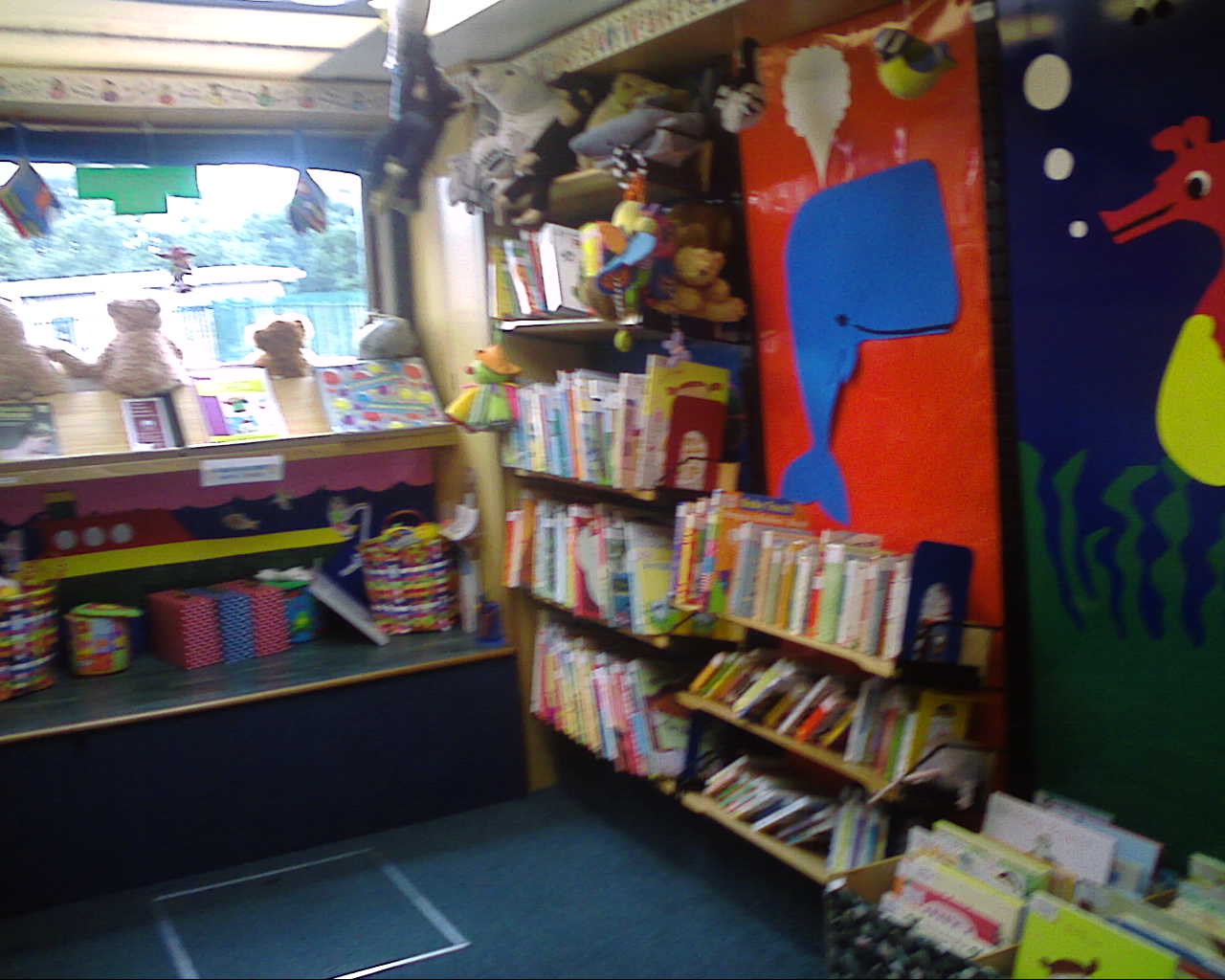
The vehicle is currently run by Diane and Lynne. They always work with a driver who could be one of a pool of seven,the drivers circulate like Lincoln. The driver of the day during my visit was Karen. She has worked in Libraries for the past 30 years and has driven a mobile library for the past 15. Both of the staff I saw today love their jobs and are dedicated to the service.The aim of the service as far as Diane is concerned, is to break down barriers. She feels there is more to their service that just giving out books, part of it is being a role model and another caring adult in the children’s lives. She has taken over the post from the woman who set the service up. The vehicle is a “Leicester coach builders” vehicle. The inside is pleasant enough, the shelves are pinky purple and the carpet blue. There are two padded seats at the back and lots of shelves that go up to head height only. The shelves are all face on, and there are a number of spinners. It has a public laptop, the only other one that I have seen since my days in the Reading Rocket, The outside is cream with illustrations by Paul Stewart and Chris Riddell.

The Stockport Storybus is quite different. It's target audience is children under the age of five. It operates with a team of three people, Christopher, Carol and Alison and it is managed by Sarah.

This service was started in 2001 as part of the sure start service. It still has a sure start logo on its livery. It specialises in under fives and visits under fives groups, schools and nurseries, children’s centres and has community stops, Alison and Christopher also deliver Bookstart books, tell stories in clinics and work with parents and children. Much of their work involves modelling storytelling for parents, so that they can do it with their children at home. The team also train Sure start staff who have little confidence in storytelling.Today was the last day of term and I had the privilege to meet the whole team.
The vehicle is on the road three days a week, and has eight stops a day. The community stops are usually very busy with parents and grandparents bringing their children and grandchildren on board. The interior is colourful, decorated with nursery style scenes, only a few book shelves and a number of kinderboxes on the floor. It is a large space, dedicated to storytelling activities. It was a lovely end to some very fruitful fieldwork.

Monday, 28 June 2010

New children's library bus hits the road - Oxford Journal

Oxfordshire have three mobile libraries that cater for children. The latest one is a mobile children's centre, but I may have mentioned that after seeing it at the Mobile meet. It was shortly after then that I managed to observe it in action, during the first time that it had been out in a holiday period. It is beautifully appointed, with a plasma screen to show presentations and video's to parents and lots of toys for babies and toddlers. The two ladies who run the vehicle are both very experienced child care experts and newly experience library assistants. they have picked up the skills really quickly.


Parents were greeted with the offer of a hot drink, and children were read to and borrowed lots of books. Everyone seemed very impressed with the bright and relaxed atmosphere and we all got treated to some nursery rhymes spontaneously sang to us by one of the three year olds.

Monday, 24 May 2010

The Bexley Children's Library

The Bexley Children's Mobile Library is managed by Jacqueline Luckhurst who has been involved with the service since it officially started seven years ago. During that time she has seen the development of her customers as they progress through school and move from "Where's Wally" books to the "Darren Shan" series. Jacqueline has two part-time driver assistants, although she can drive the vehicle herself. When it goes around schools and children's centres or in parks at holiday time, it is double staffed. This means that Jacqueline is able to spend a lot of time talking to the children and helping and advising them as they choose their books.

The children's mobile library only visits schools because that is the place to find children. The service is available for the individual child. The interior is decorated with children's work from all the schools it visits, created specially for the vehicle. On my visit they were displaying a dragon and St. George that was done as a celebration of St. Georges day.

Thursday, 22 April 2010

Leicester bookbus


I have now spent a morning and an extended afternoon on the Leicester bookbus. The promotional work at a primary school on Monday morning stirred up some interest with the children, because when it visited the school at home time on Tuesday (a regular, weekly stop) there were several new customers all keen to join and borrow books. The staff have developed a rapport with their regular customers out on the streets of Leicester. Many of the children I spoke to were very enthusiastic about the service and would not have borrowed books from anywhere else. Parents and children alike said that the chance to borrow books helped them with their reading skills.

Thursday, 4 February 2010

Leicester book buses


Well here are a pair of book buses! Today I went to see some very nice people from Leicester city libraries children's team, who manage the Leicester book buses. I managed to look over the vehicles while they were back in the depot for lunch. The under-fives BookBus tours settings in the city with a specific driver-library assistant and a children's team member, telling stories and issuing books. The children's BookBus focuses on area's of the city where the need to improve literacy is greatest. this means that although the timetable is fixed, it changes from time to time, when it has done its job in one area, most of their clients also going to a static library, and there is more need or no provision in another.

During the morning it does promotional visits to schools in those areas, to tell stories and talk about library membership. It rests in early afternoon to come out again between 3pm and 7pm to stop in the streets so that children can use it. They both stock mainly fiction, with just a little non fiction. It also attends community festivals and council events. The service has been continuous for the past 30 years, so as far as I can tell, it is the oldest continuous service in Britain. They have worn out three lots of vehicles in that time. Tell me, anyone, if their service has been going for longer!

Friday, 14 August 2009

Lincolnshire Mobile Libraries

I visited Sleaford yesterday, which is an attractive, neat, clean town set in the Lincolnshire countryside and where there is a mobile library depot. The Lincolnshire mobile library service went through a major change about two years ago. Being a large rural county they had eleven mobile libraries generically servicing villages and rural communities. Some villages had trailer libraries visiting for a day at a time. Some rural customers had books taken into their homes by mobile library staff. Many of the stops were at village primary schools. When the service was analysed in its entirety, it was realised that a generic mish mash of stock on each mobile was not given enough choice and selection to each genre of customer, If customers come in Genre! The fleet was sorted out to specifically target certain people, and certain situations.

Each mobile is now specialised, either to be a local library substitute, or for home deliveries, or visiting care homes. Most significantly for me they have three vehicles dedicated to visiting primary schools, where the children come on board and choose books, and two underfives vehicles that go to nurseries and play schemes where stories and activities are told. All the mobile staff are timetabled to work across the scheme and work on each vehicle. They are expected to work one day with elderly people and another with underfives. Drivers also have to drive all the vehicles and cover each other when necessary . There is one relief driver who is part of the team and can be called on when necessary.

When the service changed, there was a large reshuffling of stock, the children's vehicles were stocked with books existing in the service, and from begging and borrowing from other libraries. All was achieved within the fleet budget. The fleet vehicles are leased, the livery is included with the package and old vehicles get replaced. The service also appears to have strong library and council support. The changes happened when the mobile fleet manager was appointed. The home visit vehicle was so successful that the council has paid for another. What impressed me was that all of this was achieved by thinking logically, using what was available and adapting it to need. There appeared to be no large blazoning of trumpets and flag waving with fancy and expensive vehicles. It initially appears to be a good, cost effective model. Whether literacy is purveyed with the books, and if the visits have an effect on the children is yet to be found.

Monday, 30 March 2009

The Role of Public Libraries in Literacy Education

These are notes taken from Maria Elena Zapata's article, " The Role of Public Libraries in Literacy Education" published in Libri 1994, vol 44 no 2. At the time she was Director of Public Library Networks in Caracas, Venezuela. In this paper she makes many points about the delivery of literacy in a global context that can be applied anywhere in the world.

She speaks of literacy as a new concept of social development. She wrote this 15 years ago and now Britain certainly considers that literacy is vital to social development. (Insinc, Framework for the future, Peoples Network). The focus is again on the prevention of illiteracy, defining the problem of illiteracy as "an expression of unequal access to social wealth, information sources and knowledge," and "Illiteracy: and expression of inequality". She also explains that literacy is not simply a matter of someone being able to decode the marks on paper into words, there needs to be meaning an understanding in the mind of the reader. They need to acquire functional literacy, which allows individuals to participate in social development. With this in mind, libraries need to provide information resources to "People Participating in Literacy education". My argument is that a Children's mobile library provides the resources in the places where children are learning to read, or should be learning to read, the question being "Can Children's mobile libraries help prevent illiteracy?" I have just checked the UNESCO website and the figures that they quote as being the most current is 774 million are illiterate globally, and 64% of those are women.

Zapata argues that illiteracy is not only a symptom of poverty, but a cause as well meaning that some levels of society cannot access their human rights. She explains "Knowing how to read and write is the prerequisite for practising the right to learn which is one of the conditions for the effective and universal application of these principles." It becomes a self generating circle. The process of learning to read gives people the skills to "Access and Process information, to create apply new knowledge, to participate in social processes designed to modify the environment and create better living conditions at individual community and national levels." Even in a democratic society citizens need to know how to read and write at a reasonable level to be able to "understand, analyze and reflect on their personal and social situations and to become active participants in promoting changes". To correctly exercise your vote you must be able to understand the policies of the political parties and chose the one that suits your own opinions.

As a logical first step and a way out of an illiteracy circle, is to teach reading and writing at an early age. Then, Zapata continues, pay attention to the young people and adults who have not attained adequate levels of reading. Libraries can help their literacy in two ways, as a partner of educational intuitions and as a service unit for the general public. A children's mobile library can have this dual function with great ease. It can tour around from school to school working in a tailored way to each educational establisment, and it can go out into a variety of communities to provide resources, skills and advise to members of the general public. The ways in working which Zapata suggests for a static library include the training of teachers and of librarians, both working together to assess and discover literacy teaching methodologies and the access to a range of appropriate printed materials. She suggests that static libraries provide travelling boxes of books and materials to day care centres, well, surely a whole library is a better option, if available. She suggests the provision of information about services offered by the library. the Leicester book bus goes one further that that, it provides information about the city's literacy policy, including schools. Finally she considers that staff should be trained as story tellers to continue the oral tradition. This applies particularly to staff on children's mobiles, they are an efficient use of trained staff, who will use their story telling skills multiple times during one day, instead of a few times a week.

Zapata also believes that libraries need to provide books to children to promote reading for pleasure. Because Zapata wrote the article with a global perspective, she suggests the "Artisan production of reading materials which rescue and give new value to the oral traditions and values of indigenous cultures". She is considering the places where the libraries' users are ethnic groups, some with no official language, but it is equally appropriate in any place. Making books for children, with children and by children gains their interest makes them realise the purpose of books. They end up with a product they feel ownership of and interests them which motivates them to read. Making books is a large part of the Peers Literacy intervention. It was also a large part of the reading policy of my eldest child's' school in Bristol over 20 years ago.

In the conclusion of the paper, Zapata stresses that public libraries are a "Vindication of Democracy" because it is in a library than anyone from any social background can find anything that interests them. If that is true of a static library, then it is also true for a mobile library that can go into the communities to allow any child a democratic choice.