Pages

Showing posts with label libraries. Show all posts

Friday, 26 May 2017

The Trouble with ISBNs

This is a post that I wrote for my work blog. ISBNs seemed like such a wonderful idea as a way to identify a unique work, but that was in the days of books being only in two formats, hardback and paperback. Now they could be anything, and the quantity of ISBNs are increasing rapidly. Perhaps it is time to have another think about them.

img_20170224_111933

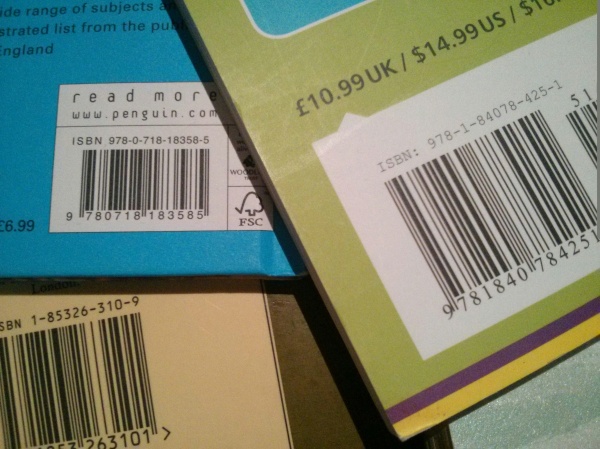
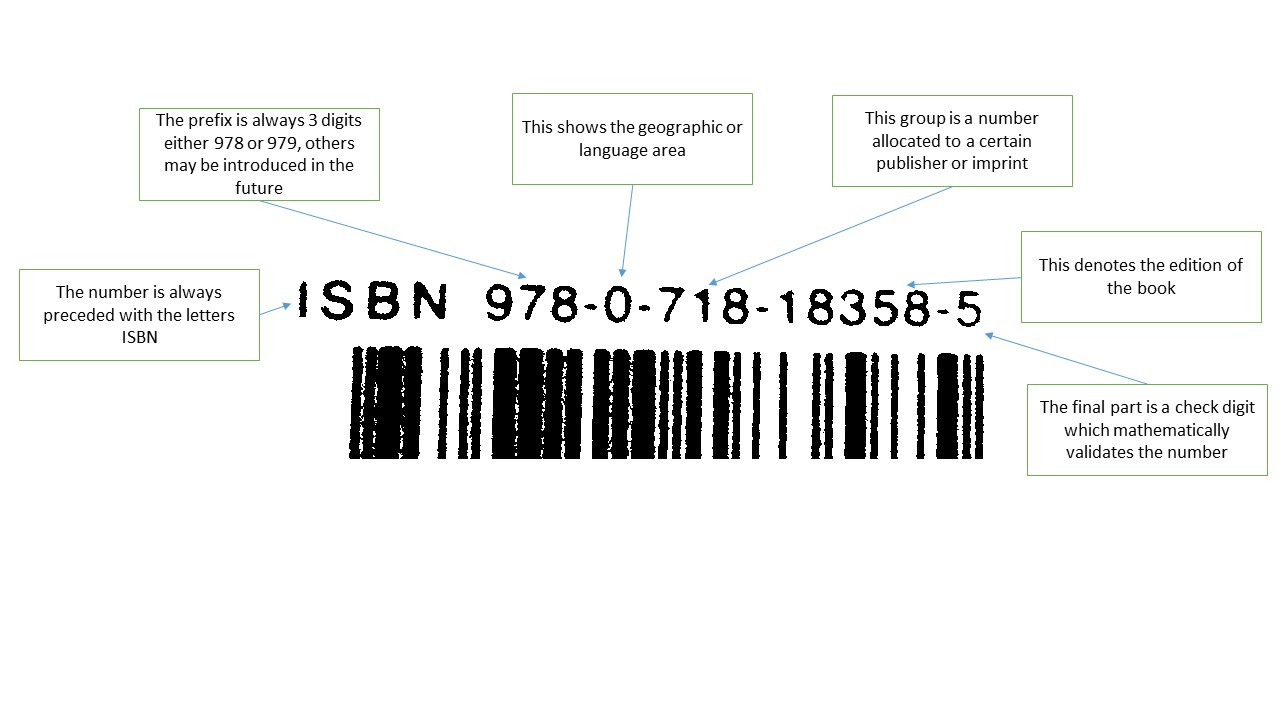
 As a Librarian and shuffler around of books I have found International Standard Book Numbers (ISBN) to be really useful. Unlike what is portrayed in popular media the role of a librarian is not to stamp books and go "Shh" at people aggressively. It is our job to find things and to put things in the right order or place so that other people can find them too. I like to simplistically say that the purpose of a librarian is to sort things out into piles and that is a reasonable basic analogy of what we do. We take the things that hold knowledge, such as books, scrolls, documents, vinyl records, compact discs, digital texts, databases, e-books, anything and we make them "discoverable" by arranging them in ways that are  easy to find. So books can be sorted out into the type of knowledge that they contain, such as History, Geography, Religion, Science and so on. There are many ways that things can be sorted, which is why there are many classification systems - Dewey Decimal, Library of Congress, for example. A book is assigned a particular classification number according to the knowledge that it holds, its content, so there can be many books attributed to the same number. Of course the titles and authors are different. So, what if you want to find a particular book? This is where ISBN numbers come in handy. The number is an official International Organization for Standardization (ISO) standard  which was introduced by the book trade in 1970 to identify one publication or edition of a publication published by one specific publisher in one specific format. It was set up to allow automated machine reading of books, or "book like items", such as maps. The thirteen digit number is made up from smaller number groups that have been mathematically calculated to represent different elements. Let's take one of the numbers from the books in the photograph above.
  isbn-explained
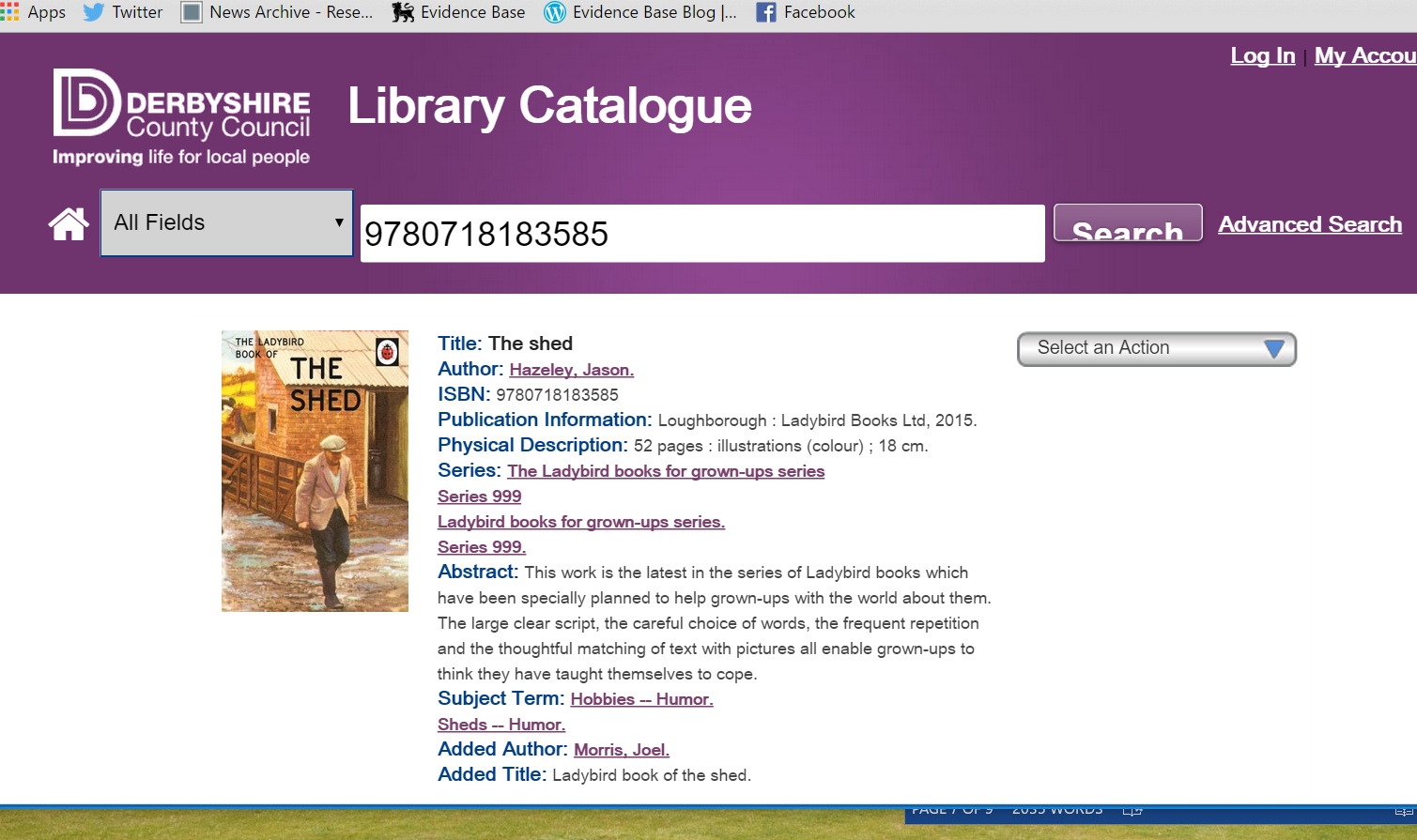
 The number above shows that it is an ISBN (preface), it was published in the UK  (geographic element), it was published by Ladybird Books (publisher or imprint) and it is this particular book (edition). In fact it is a hardback book titled The Shed. The machine readable part of the ISBN is the bar code, which can be scanned by a supplier, bookshop staff or library staff to identify that particular publication. ISBNs are issued through national agencies and held on their databases. This means that if you know that you want to buy a copy of the Ladybird Book of the Shed and you have its ISBN number you can type that in to Amazon or a library catalogue you can find out where to buy or borrow it.

  Untitled

So each ISBN number is a way of identifying that a printed, hardback copy of the title "The Shed" written by J.A.Hazeley and J.P.Morris was published by Ladybird Books Ltd, Loughborough in 2015. If the publisher decides to sell a paperback or e-book version, or the author wants to update or correct the words or change the illustrations in a second edition, then each one would have a different number in that edition element. Great, perfect for identification - by a machine. Just imagine that you are a  librarian you only want one copy of The Shed and you don't care whether it is hardback or paperback, or you are trying to make space on your selves and only want an e-book and all you have is a long list of numbers and you can't work out which is the e-version, which the paperback and which is the one with different pictures. You see, the "edition " part of the numbers is a unique grouping just for that instance of publication. It is not a code that means e-book, or hardback, or third edition. This is the problem with ISBN, they are just too unique sometimes.

What is needed is an identifier for the intellectual output of that book, whatever the format. Now, I am not very well acquainted with these, but in searching for information for this blog post I have come across International Standard Text Code (ISTC) identifiers. This appears to be a number allocated to the textural content of something, no matter what is wrapped around the outside, metaphorically. So, perhaps these are the numbers to use at a time when any piece of text could available anywhere in any format and the variety of format choice just keeps growing.

This blog was first published on 24th March 2017 in Evidence Base Blog https://ebasebcu.wordpress.com/2017/03/24/the-trouble-with-isbns/

Thursday, 2 October 2014

Blog Lag: Library Camp 2014 and FLA

Oh dear, this not having a full time job problem seems to be making me very lazy. A few years ago if I attended a conference I would blog about it straight away before I forgot anything, but now I seem to put off the blogging until I have done other tasks on my list list. My excuse for not blogging library camp 2012 straight away is that I had to go to Nottingham early on the following morning (early for a Sunday that is) and talk to librarians of Women's and Feminist Libraries at their regular gathering (FLA). My reason for not blogging about FLA is that I had to finish writing a paper to take to my ex supervisor/colleague/co-author in Loughborough University, and while I was there I managed to pick up some teaching work, then I have had to do some planning, and so on and so on. So, or I really should say Therefore, there were a lots of "so"s in that last sentence, to catch up quickly I am doing a brief blog about both, and I may well do some longer blogs about some individual sessions that I attended in Library Camp 2014.

This year Library Camp went to the distant climes of the north east, Newcastle, (upon Tyne) and it seemed that many of the plucky people from down South couldn't find the pluck to venture on such a hazardous journey, (my apologies to the person who got up at some unearthly hour of the morning to get there, at least you had the pluck) because numbers were distinctly down. However, the delegates that did attend were definitely from the brightest and best because an interesting and stimulating time was had, yet again. The conference format ensures that each year it is different and manges to produce session facilitators who are passionate and interested about the topics they suggest.

I went to one about an initiative called "Common Libraries" which are dedicated spaces that have the actives wanted by local people taught by the local people. The trade is in Knowledge, facilities and resources are provided for someone to teach a craft or skill and share it by writing down what how to make something putting a "maker kit" in a "maker box" which is borrowed by someone wanting that knowledge. The prototype is happening in Colchester. Then I found out about Community Interest Companies and Industrial Provident Societies (IPS) because York Library service has split with the city council and has become an IPS. This was very illuminating and shows how a library service can fight back, and the problems that councils have being run as councils (the quotes for supplying new carpet went down significantly after the library was not part of the council). I ran a session myself, trying to define what a librarian is and what a librarian does, so that will be blogged about separately. Finally, I attended a rather un unconferency presentation of "Dawn of the Unread". This is a fascinating concept being done in Nottingham to try to engage children with more reading. It is currently a series of one off online graphic novels about Nottinghamshire literary characters (Such as Byron Clough and DH Lawrence, Vampire Hunter) which have embedded links to other interesting stuff.

Other good things about Library Camp is meeting people who you would otherwise not meet, getting to see familiar faces again and above all the discussion with like minded people, and the hope that libraries will again struggle through the silly imposed cuts.

The FLA meeting was altogether different, just 12 of us, with two ladies from Japan. I was there to talk about Wikipedia Editing and the representation of women on Wikipedia. Women's and Feminist Librarians are very keen to make sure that notable women take their rightful place in history and that more women should edit English Wikipedia, as it appears to be flooded with young white American males (according to the Wikipedia Foundation). I found the gathering very illuminating, I have visited a Women's library, but I did not know about Feminist libraries. Feminist libraries are trying to document the history and development of the Feminist movement, with collections of music, books, images and oral histories.

All in all that was a busy but rewarding weekend, something to record in more depth for my Chartership portfolio. But now the other half is home from work, so I have to leave my trusty laptop and make his dinner! (actually, I am more of a feminist that that, and so is he!)

Wednesday, 2 October 2013

Only little, but doing a lot

Well that title could apply to me, those who have never seen me don't know that I am only 5 foot tall, but that was the height when I last measured myself. I am way past the age of having grown anymore, so yes, I am little, and I do do a lot, working, writing, painting, gardening, bogging (sometimes!). However, the title does not apply to me, but to this lovely little bookmobile from Batram Trail in Georgia,, USA.

http://boingboing.net/2013/10/01/ford-transit-modded-into-mobil.html


I would like to have one of these to drive around, telling and reading stories and inspiring children to love books.

Wednesday, 17 October 2012

Librarycamp12: Yet another conference (or unconference to be precise)

I really wasn't sure if I wanted to go to Librarycamp this year. I had enjoyed the first one last year, and indeed the regional one in Manchester. But I was apprehensive this time, because so much has happened to libraries this year, with public libraries closing, funding being withdrawn, everyone tightening their belts and I could see no positive outcomes that had happened as a result of the first Librarycamp. I was also a bit dismal about the lack of response to my job applications, or the responses of "We have had so many candidates of a high quality..." I know that there are a lot of librarians out there looking for a very few jobs. I thought that the atmosphere would be all doom and gloom. I was very wrong.

I returned home that night, very tired but also in a much cheerful mood. The sessions that I attended were positive and provided their own immediate outcome. The subjects discussed were all different from last year, with different facilitators (at least the ones that I went to were, there may have been duplications). Everyone there was in a good mood and contributed to the discussions in a positive way. My only complaint was that the day started at 9am, and for reasons that can't be revealed in this place, I found it very difficult to get there so early on a Saturday morning. I will just say that it had something to do with airports and collecting someone late night/early morning. I therefore missed the first set of sessions, and didn't pitch for one myself (I managed to hi-jack a few later though).

My first session was the one about the happiness index and libraries. I have an interest in the subject because one of my talks, or workshops, is about "How libraries can make you happy". Unfortunately I didn't glean very much from that session, the discussion did not flow, and we never managed to settle how libraries could monitor their effect and show benefit from measuring happiness. It is a very subjective and abstract idea, especially as  the happiness survey is a quantitative online survey based on few questions. Perhaps it was a hard topic to tackle.

The second session I attended was about the problems associated with opening research collections to the public. Over the past two decades or so, while I have been studying or studying and working, I have thought that it would be really useful if I could access academic libraries more freely. Also, while standing in the library for my University I have thought "This could be a wonderful resource for the Town, why don't they open it to the public?" It seems that Universities and research intuitions now realise that they are getting tax payers money, and maybe those tax payers would like to see what they are paying for, and they mean more that just digitising their collection and putting it on the web. Initiatives that are already happening include a travelling archival display that is touring Wales, various co-operative schemes between academic and public libraries, and the Ultimate in Co-operation, the Hive in Worcester, which is not only a building that contains many council facilities, but also has integrated the public library and the academic library, both collections being shelved together and one ticket for all users. What I also found inspiring is that the Hive contains a large display area that exhibits materials and expertise from the libraries, archive and archaeological sectors to a three monthly changing theme.

My next session was collaborative. It was about storytelling in Libraries and most of the people who came to that session are practitioners. The idea of the facilitator was to share experiences and we did. I talked about storysacks, we sang some songs, talked about most requested Rhymes, and then realised that one amongst us had come along because she thought we would be talking about storytelling from a knowledge management point of view, She stayed because she was enjoying herself. That session was fun, and practical, I have come away with more ideas to use in story sessions. There was just the glimps of a suggestion that perhaps there should be a storytelling camp. Perhaps it could be arranged.

The following session was about repairing books, which wasn't quite a practical demonstration, but almost. I would love to go an a book restoration course and there were many helpful suggestions of places that run courses, demonstrations on youtube and a shop that sells supplies. There was a little discussion about the worth of repairing a book as opposed to buying a new one, which of course would depend on the cost of the book in the first place, and how easy it is to get a replacement  We deviated slightly into the use of old and discarded books into art objects, and were informed about the "library of lost books" which is a project for artists to use the books that have been discarded from Birmingham Library because of its rehousing. I realised that I could practise on my own collection, I have a lot of old books and I collect things such as ladybird books and Victorian children's novels. Definitely a positive outcome from that session.

The final session was really inspiring, it was like a call to arms for all librarians, to go outward into the world with all their skills and be librarians in every situation. I found out about the American Librarians that call themselves Radical References, who started by supplying information to protesters at a Republican party conference in 2004. They have gone global, with Chapters in various parts of America, the Boston Chapter supplying information to Occupy Boston. Another enterprising Librarian takes leaflets and information on planes, being the "Inflight Librarian". The facilitator of the session is herself an "itinerant librarian", taking poetry into clubs in the early hours of the morning. She believes in "Going where people are". One of the group worked with scientists and he told us of plans to do "Science Busking": demonstration of experiments in a shopping centre. the whole idea is that a librarian doesn't have to be attached to a place with walls, the collection could be information on a USB stick, or a bag full of books or leaflets to come out at the right time. My conclusion to this is maybe I should go around with a selection of storybooks, or take gardening books down the allotment (actually, taking them to Gardening Club may be a better idea).

The best bit of the day was being with like minded people, and the chance to meet them in the between sessions time. I look forward to next year's National Librarycamp and the surprises that it will bring.