Pages

Showing posts with label bookbus. Show all posts

Friday, 23 June 2017

Some are good, some are dubious

I have been looking back over my collection of Google Alerts again to weed out the interesting articles from the gathered emails of schedules of bookmobile of mobile library routes. I considered whether there was any historical reason why I should save the schedules and from a big data point of view, that may be interesting, but I decided against it, think that if they are still on the net from 2013, then they should be there if anyone wanted to do a heat map of the mobile libraries driving across the USA.

I did come across some interesting articles two of which are rather unusual and one just cheerful. I also came across some news items of mobile libraries closing, or being under threat. Together they show that although there are very good things happening with Mobile Libraries there are also bad things and sometimes people's motives may be a bit dubious. There are a lot of thoughts in that sentence, so lets take them one at a time, starting with the bad things.

 Bad things

Mobile Libraries, and specialist children's mobile libraries (CMLs), are easy targets for budgetary cuts. When I traced the history of CMLs I spotted the pattern of them popping up like mushrooms at various times, living for a number of short years, then, just like mushrooms disappearing for a while, sometimes to reappear after several years when another grant was available. In the UK over the past few years there has been enormous pressure on local authority funding and libraries have taken the full thrust of savings. So in 2013/2014 I found a number of articles about threats to mobile libraries in rural locations which were considered a life line to the local communities. I am not sure whether the mobile library services were actually cut in the end, something to pursue another day.

The UK was not the only country where mobile libraries have closed and isolated or minority communities are the hardest hit. I found an article about one in the USA which had been running for over 50 years, and had many visitors from Amish communities and one from Canada too.

I thought that I had found a good article when I saw the heading "Peace Corps Brings Bookmobile to Isolated Georgian Communities", from the Philadelphia News. It refers to Georgia the country between Turkey and Russia, not the US state of that name. I am not including the URL because the site is full of adverts, some of a dubious nature. I am sure that you can find it if you google it. However, I have my doubts about the ethics of that particular bookmobile:
  • The vehicle is a converted school bus from the US - What is wrong with using local vehicles?
  • It is operated by the US Embassy
  • Although targeted to the youth in the settlements, it "promotes American Culture" - What is wrong with Georgian culture?
  • The books are in English
Now, I believe that the Embassy and the Peace Corps consider that they are doing a good thing for those youth, and learning about other countries is a good thing, but if you are trying to engage displaced young people and help the disadvantaged then  at least start with what they know, their own language and culture. I just get the uneasy feeling that this bookmobile may be more about propaganda that altruism.

Good things

The first good thing, to counter library closures, here is a library opening.This is an example of a service that paused until money was found to start it again. The community is rightly proud of bringing back a service that will mainly serve schools, but will then visit other parts of the community.

The second good thing is a bicycle mobile service. Now, I am sure that you have heard of them before, but this one is not in Peru, or Cambodia, but in Arcata, California.
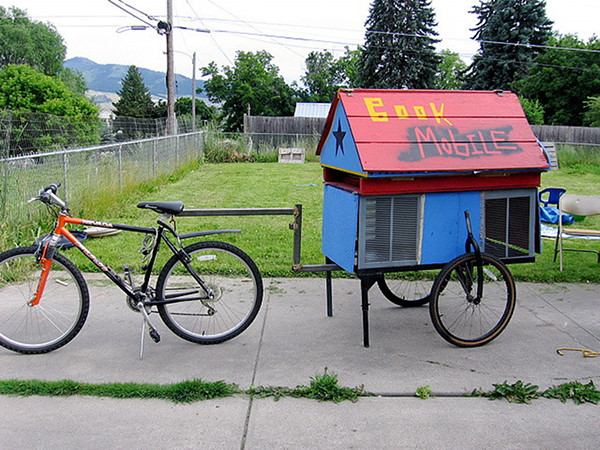

The project, as it was in 2014, was the idea of university teacher and bicycle enthusiast Melanie Williams who is combining her passions of teaching, literacy and cycling. All the books have a cycling theme and she explains her reasons for doing this in her interview with the local radio station. Part of the interview is about the Book Mobile and the latter part about her work in promoting cycling. If you have 15 minutes to spare it is well worth listening to what she says.

Friday, 14 November 2014

An assemblage of reflections about Bookmobiles


"Bookmobile" is the very descriptive word that is used in America (and other countries) for a library vehicle that takes books and other library services around their countryside, towns and cities. Here are some links to articles where people reflect about their experiences, albeit some are brief, about book mobiles and what they are doing.

The first is a blog post that has stimulated a few answers:
http://www.thepassivevoice.com/10/2013/to-the-bookmobile-the-library-on-wheels-of-yesteryear/
I particularly like Rene's comment about her working experience in a bookmobile, and the short one by Edwin Mason. Perhaps he has now found one.

The second is from the Chemung County Library District blog:
http://ccldblog.wordpress.com/2013/10/21/the-ccld-bookmobile/
I love their nickname for this bookmobile and the fact that "you can't fail to notice it"

The third URL is rather more tricky to access, you have to go through a consumer survey before you are allowed to read the page, so I have copied and pasted the relevant article in case you don't want to do that. The article has interesting snippets of information about libraries in America. To make sure that the correct attribution is given, here is the URL:
http://www.shelbycountyreporter.com/2013/10/22/bookmobile-rolls-into-county/

Bookmobile rolls into county

Published 11:15am Tuesday, October 22, 2013
  
By AMY JONES / Associate Editor
It might surprise some of you to learn that the United States has more libraries than it does McDonald’s locations.
Or that 1.1 billion people go to the library every year, compared to the 204 million tickets sold to sporting events.
I consider myself a major bookworm — most of the time, I’d rather read a book than watch a movie or TV — so I know the lure of a great library, but those facts surprised even me. I learned those when I was touring the Digital Bookmobile, which rolled into Hoover to visit Spain Park High School and Hoover High School Oct. 17-18.
Both schools have their own digital library databases that students can access at any time with personal computers, tablets, smart phones or other electronic devices. Spain Park librarian Marnie Utz said when Spain Park launched its digital library last year, most students were immediately comfortable using e-books and audiobooks via their school-provided iPads, and were able to seamlessly go back and forth between the brick-and-mortar school library and the digital library to get whatever they needed.
As a Hoover Public Library card holder, I have really enjoyed diving into the digital world via e-books. I love having books with me wherever I go just by downloading them onto my iPhone — as much as I enjoy the feel of a book’s pages between my fingers, it is very nice not to have to lug those books around in my bag.
I’m sure Spain Park students also enjoy the lighter backpacks they get as a result of using iPads and digital books.
Bailey Hotujac with OverDrive, which distributes the digital books used by Spain Park in its library, said she sees the Bookmobile as just another chance to get kids excited about reading in all its different forms.
“Anything that gets kids reading, I’m a fan,” she said.
I totally agree. There are so many forms of entertainment jostling for kids’ attention these days — video games, TV, movies, the Internet, social media, etc. — that I fully support any method of getting kids to read, even if it includes a screen.
For more information on the Digital Bookmobile, check out Digitalbookmobile.com.
Amy Jones is the associate editor of the Shelby County Reporter. She can be reached at amy.jones@shelbycountyreporter.com.
- See more at: http://www.shelbycountyreporter.com/2013/10/22/bookmobile-rolls-into-county/#sthash.vkonENXo.dpuf

Wednesday, 2 October 2013

Only little, but doing a lot

Well that title could apply to me, those who have never seen me don't know that I am only 5 foot tall, but that was the height when I last measured myself. I am way past the age of having grown anymore, so yes, I am little, and I do do a lot, working, writing, painting, gardening, bogging (sometimes!). However, the title does not apply to me, but to this lovely little bookmobile from Batram Trail in Georgia,, USA.

http://boingboing.net/2013/10/01/ford-transit-modded-into-mobil.html


I would like to have one of these to drive around, telling and reading stories and inspiring children to love books.

Tuesday, 19 February 2013

Best practices in Children's Mobile Libraries: Stock procurement

Someone has to make the decision of what to put into a children's mobile library and as can be expected, it varies according to the authority. In some library authorities the operators advised a library purchasing team about which books or items were popular and went well in their vehicles. Some purchasing teams were made up of children's librarians, but in others they were not. In some authorities, the operators had no say at all, library stock being centrally purchased from a Library wholesaler. It is perhaps no surprise to discover that the services where operators were able to advise the acquisitions teams about which books their customers liked were more successful at inspiring children to read. 

The number of requests for specific books, or even books of a certain genre, was much greater in the vehicles where the books were centrally purchased by staff who had no contact with the vehicles, staff from the vehicles, or even other children's libraries. I was on one vehicle that had no dinosaur books, which really disappointed one little boy. I also visited a CML which had no horse books, and that really disappointed a young girl. On the other hand, I found two different CMLs where the operators had a lot of say in which books to stock and they were really enthusiastic about the books, getting books off the shelf to show me, saying things like "have you seen this one?" "this one is new, I really like it", " this is great book, and the kids love it". It is that sort of enthusiasm which inspires children. I also found two vehicles on which children told me they preferred to their nearest static libraries because the CMLs had more "books that they like". There was also the vehicle that visited a tiny rural village school. The teachers were so grateful for the service, because their children were "voracious readers" and the village was so isolated it was not easy to get to another library, and as one of the children said to me, it would have been really expensive to buy all the books she read. Those children revelled in the variety of books that the CML stocked.

Unfortunately, not even children's librarians get it right. There was one CML which I visited where the books were purchased by the children's team, who no doubt were guided by general trends and new exciting authors. The operators outlined three problems with their stock, and they felt that the children's librarians were not listening to their suggestions. One problem was that there was not enough non-fiction in stock, only a tiny shelf-full. The librarians apparently were of the opinion that reading fiction develops empathy and understanding, which is no doubt a good way to introduce children to feelings and a safe way of handling them. However, they forgot that libraries are store houses of knowledge as well as stories, and sometimes it is the knowledge that inspires children to read, or helps them learn out of the classroom. The second problem was sometimes new books would turn up, which were "trendy", but the customers of that vehicle ignored them. That new series was just not to their taste. It shows that local populations have their own opinions and a book which does really well in one community may not in another. The third problem was that librarians who come onto the vehicles to read stories from a "storybook collection" frequently chose really inspiring books, that simply were not available for loan, so children who wanted to read the book they had just heard, which happens frequently, could not borrow the book.


Now, why is all this important? I feel that I have been rambling a bit with this blog, and it is a little while since I have been thinking in the terms of logical arguments. The point is that to motivate and inspire children's reading, to give them the reason to read, you must offer them things that they will want to read, however puerile, however trashy, or even however highbrow. Books about films, or television characters, or comics, or graphic novels, or about ballet or boxing, are all a way of getting children hooked on the printed word, and gives them practise and motivation to start understanding those symbols we use to convey messages. CML operators spend a lot of time talking to children about books and their likes and dislikes, and therefore know what their particular customers want. Operators who like the stock themselves, and who have had a hand in choosing it, are more likely to know which book is just right for customer "X", and which books will be borrowed, and will have the enthusiasm to "sell" a book, or an author to a child. therefore operators recommendations for stock should be heard and implemented.

Choice and variety is also important, which sounds like a contradiction to getting the right books for the right child. I can only explain the phenomena of a large selection of the right books for one community with the memory of one boy I met, taking ages browsing at the shelves standing, looking, perplexed, being hurried by the teaching staff, sighing longingly, "There so much to choose from". His problem was not that he couldn't find anything he liked, he had found everything he liked.  

Monday, 29 October 2012

Bright Star Mobile Library: an example of a little vehicle

I have recently come across people who have a narrow concept of a Mobile Library, thinking that they are all large, expensive vehicles, but that is not the case. Here is an example of small, but perfectly formed, and very effective mobile libraries


Bright Star Mobile Library – Give2Asia

Monday, 30 July 2012

Going where other libraries cannot reach

This is the second post that reveals one of the "theories" that revealed itself during my research: another unique aspect of children's mobile libraries. Again it is so obvious that I am embarrassed writing it, a mobile library can get to places that a static library can't. Yes, I realise that a static library by the nature of it's name, cannot go anywhere, and therefore the service element of a static library needs mobile people, people who are prepared, eager and able to go out to visit the library. (You can tell I have just done a Phd, I am now all philosophical, pedantic and analytic). A library that can move can reach people who would not, or can not be sufficiently mobile or motivated to get on a bus, or get in a car, or even walk to their nearest library. 

Lack of mobility, difficulty of transport or geographic location are only a few reasons why some children do not visit their local library. Children told me that they didn't like the static library in their town, or their mum wouldn't take them, or it did not have such a wide variety of books ("books that I like"), as the children's mobile library. There is definitely a psychological aspect to the inaccessibility of a library building. Entering a box on wheels is not as foreboding. The static library opening times are also a factor, during the day, children are at school, nursery or play group. The beauty of a CML is that it can hunt down the groups of children where they are, when they are, they go to schools at school time, they go into the streets at home time, or holiday time. Children use CMLs without their parents, sometimes they have the supervision of teachers or other educational staff, but Adults are in the minority, and CMLs that stop in streets attract many unaccompanied children. This means that children can be independent of adults and learn to use a library although their parents do not.

There is a phrase that appears to be used by social scientists to describe a set of people who do not access the services of which they are entitled. These people are termed the "Hard to Reach" people who either choose not to access services or do not know that there 
are services that might help them. For some reason, library services are better dealing with "The hard to reach" than others. I looked at the way that CMLs tried to find those groups.
CMLs visit places of financial disadvantage, as well as some well to do area's, but I found
that  the socio-economic class of the child CML customer is irrelevant.

Family attitudes to reading, books and literacy, negative or positive, cut across socio-economic divides, therefore, the CMLs need to go to all area's to capture the children who's parents are not that bothered about books in the home. I attempted to find the dominant socio-economic or ability group of CML visitors, and I have to say that no specific group of any type dominated the visitors that I met. They were a complete mixture. In that mixture were children who's families certainly encouraged reading, and some children who were so far advanced in their reading skills, in ability and speed, that an ordinarily household would not have been able to hold all the books the child read. Those children certainly benefited from a free, never ending supply of reading matter. At the other end of the scale were children who were afraid of touching books, or did not know how to hold one and turn the pages. These children were gently encouraged to have a go, and  at least gained the experience that books contained words and pictures that were there to convey a message. Two things can be concluded, the CML is of use to children of every ability and, in order to reach the hard to reach, and children of low ability, you have to take the total mixture.

It is rather unfortunate that only a very small percentage of the child population of the UK actually have access to a CML. When I wrote the thesis, about 9 months ago, 16 local authorities of a total of 228 operated 26 children’s mobile libraries in a range of geographic locations. From my current investigations, this has gone down to 12 authorities and 21 vehicles, a sad reflection of the economic climate. However, the CMLs that I know about visit children located anywhere. Not all CMLs go to all the types of location on the following list, for various reasons, but at least one CML go to such places as Schools, Special Schools, Nurseries, Pre-school groups, parks, streets where children live, children's secure units, traveller sites, fair-ground permanent sites, farms, urban areas, rural areas, inner city and city estates. If one CML can visit such locations, then surely others can also. Although CMLs do not visit each child in the UK, they hold the potential to do so. CMLs can reach all children of all abilities. 

The above diagram shows my simple argument. It just needs funding and the will to achieve such a situation.


Tuesday, 24 July 2012

What two entires in one day?

Record Gazette > News

This is a link to a webpage about a children's mobile library that has been commissioned for a literacy improvement project. I am pleased that someone with money and authority can understand the contibution that such a resource can have to literacy 

Reading for boys.

 I have not yet read the detail of this report,( Boys_Commission_Report.pdf (application/pdf Object) but the executive summary suggests that there is absolutly no reason why boys should not be reading as avidly as girls. There is no strange quirk in the male brain that stops boys from enjoying reading. I also believe that boys DO read, because I have caught them at it, devouring books, magazines, web pages, newspapers in a school library, on children's mobile libraries or at home. The problem appears to be more the fault of adults. The exectutive summary of this report says that adults expectations of boys are at fault, teachers don't know about the right books, adults don't buy the right books.

The point is, adults don't look and take note of what the boys are reading, for example the sports pages of a newspaper, or a website about their favourite online game. The exective summary concludes that contact with a regular (weekly) male reading role model gets boys into the reading habit. During the time I spent working on and researching children's mobile libraries I observed many males being a reading role model. Not only male CML operators reading stories aloud, but also male operators quietly reading to themselves in full view of the children and male parents reading to their children (male and female). Male operators also praise boys' reading and discuss their choice of book with them, as an equal because the operator has read that book.

There are a number of other reasons why childrens mobile libraries are a conduit to boys reading enjoyment.
  • They can choose whatever book/reading matter they want from a wide variety, uncensored by parent or teacher (mostly)
  • They are in an enviroment where reading is accepted by their peers
  • They respond well to the individual attention they recieve on a CML and the informal situation
  • The nature of the learning environment found on a CML including humour, fun and adventure, matches the learing style of most boys. 
So, my solution is, get more children's mobile libraries, and send them out into the world seeking out boys, luring them out fom behind their computers and draging them from the playing fields! 

Friday, 11 May 2012

And now dear readers, it is time to reveal all!

I should have mentioned, on the 4th of April, that I did become a Doctor! The Thesis was duly defended and passed, subject to corrections which are not too many or too difficult. It is now time for me to tell the world about what I found. I will do this by breaking down the findings into small, post sized pieces and when I have done all those, I will do case studies of each vehicle that I observed, anonymised of course. This task should keep me occupied for a while!

Today's contribution is about the thing that is special about children's mobile libraries (CML). I defined a children's mobile library as a vehicle that provides all the services of a static children's library, but I felt that as I was specifically investigating mobile, not static children's libraries, I needed to find the element that made them special. Otherwise I could just have observed any children's library. I admit that what I discovered was blindingly obvious, children's mobile libraries work because they are mobile, they come and go away again.

This transience has a number of effects. It makes children and their parents or carers excited about visiting the vehicle. The excitement that children feel stimulates their brains into the right sort of state to absorb information therefore they learn better. The coming and going ensures that customers "Catch" the vehicle, they know when and where it is coming, so they make the effort to go, unlike a library that is always there, so you could choose to go whenever you want to but end up not going. I had not done very many observations when I noticed that one phrase was repeatedly told to me by many people. They liked the CML because it was "Different".

It was different because it was "Like a trip out", because the books were different, because the stories were different, told by a different person in a different way. The idea of this different thing that turned up out of the blue every fortnight, or three weeks, or month captures the imagination, and the anticipation of the event makes people, especially children, excited. Now, as an ex-teacher, I know that half your battle in controlling a class is stopping them from getting too excited, but it turns out that to learn well, you have to have certain amount of adrenaline and nor-adrenaline flushing around your brain. This wakes up the brain, relaxes it but also makes it alert, just what you want when trying to get the little dears to learn something. So, if you have all these children coming onto a vehicle stacked with everything to do with literacy (books, videos, stories, computers, pictures, words), their brains are picking up all the clues they need to piece together the jig-saw of reading ability.

But what happens if the brains are constantly stimulated? There is no time for feedback, for reflection, for setting down the experiences into memory, so you need a time of calm.This happens when the CMLs go away, and life returns to boring reality of the classroom, or nursery, or home and dinner. That sort of time lets children sort out and make sense of the things that they have just seen and heard. Remembering the story, for instance, or recalling a picture in a book, or thinking about the book they want to borrow next time or the enjoyment of the one that they have in their hand, just borrowed.  I have a diagram to explain all this, which I will put in here.
"Build up" is what happens when customers are expecting the vehicle, "Occurrence" is what happens inside the vehicle and "Release" is the moment of calm and thought after the vehicle has left.

There is also a theory by someone called Carmelli, that travelling shows, which seem to appear overnight and disappear just as quickly, attract people because people feel that they have a brief moment to experience a small part of something eternal, that keeps circling around forever. Mobile services certainly seem to attract the human mind, just think of ice-cream vans, and what a treat it is to have one in your street. It takes a mean parent to refuse a child an ice-cream when the van comes into your road, even if it is nearly lunch-time. Children's mobile libraries feed off this sort of attraction.

If you want to follow up Carmelli's work the reference is "Carmelli, Y.S. 1987 Why does Jimmy Brown's Circus Travel?: A semiotic approach to the analysis of circus ecology. Poetics Today, 8(2). 219-244". There are many books available on education and the brain.

Wednesday, 4 April 2012

Doom day

Well, I started this blog to be a story of my research about children's mobile libraries in the UK, and in recent months I have only been adding links about interesting children's mobiles I have found in other parts of the world. That is because all the research has been culminating to today. It is the day of my Viva Voce, my "Oral examination" when I will find out if the research and thesis will be accepted to be good enough for a doctorate. I have been looking forward to this and being scared by this. I have just done a check on websites of the various children's mobile libraries that I visited, and I am a bit sad because at least another two have disappeared, which leaves only half of the ones where I did observations. My moral dilemma is should I have published my work sooner? or have the CMLs just got too expensive to run because of the rising cost of fuel?

It really is time to have another search through local authority websites to check how many CMLs there are in total, but I won't manage to achieve that by 2pm today (that's the time of the viva). So, don't think that this blog is coming to an end, just because I have finished one journey doesn't mean that I won't start another, and more importantly, now after the work has been marked I can say more about what happened on the journey. I am planning to write case studies of each vehicle where I conducted observations, those will have to be anonymous, of course. I can tell you general stuff about all the CML's that I could find, even the ones that have gone, let this blog be an archive of their work. I will also put up my findings and diagrams I drew to understand the information that I found.

I am also writing a paper about storytelling on CMLs and I will report on that and subsequent papers. I really did gather enough information to keep me going for years. (But I do need a job now, so if anyone has a spare one out there, I would be grateful!) Anyway, to keep my list of CMLs up to date, it would be good if anyone out there could tell me if they know of a CML that is still operating in their area, or if any new ones are planned. If the reverse is happening, and if anyone knows of a CML closing down, then I will be more than happy to offer my services as an expert witness to the value of using a CML.

Oh, in case you are in doubt, I did prove that CMLs do spread literacy and a love of books.

Friday, 29 July 2011

Thesis written

Well, the thesis is currently in University waiting for my supervisor to read and tell me what is wrong about it! My journey, I hope, is almost over, although I will write up more about my findings once the PhD has been passed. I particularly enjoyed doing the field work and feel very privileged to have met some interesting people with stories to tell about their experiences of children's mobile libraries. I was welcomed at each vehicle that I visited and I was quite enchanted by the actions of many of the children, I feel I saw some special moments in children's lives. More about that another time.

Overall, I found out that children's mobile libraries (CMLs) do pass on a love of books and reading to children, but not in the way that I thought they would. I thought that children's mobile library staff (I have been calling them operators) would need to have an in depth knowledge of literacy and working with children, and each vehicle would have to have lots of story times and active teaching, but that is far from the case. If you are a CML operator, you will scoff at me, you will say that you knew you were helping children's literacy and changing children's lives. Yes, many of you did tell me that. I can now prove that you do.

Children's mobile libraries work because they are a vehicle that comes and disappears again. that makes children (and staff) excited, which opens the brain to learning experiences. On the vehicle, there are books, books and more books, or posters about books, or toys of book characters, or recordings of books, or someone reading a book to you, with the occasional computer for children to play with. Basically, once you have entered the realm of a CML you cannot escape from words. This space of words is controlled by the operators, who tease you, cajole you, ask you about the book you have picked up, wants to know if you enjoyed a story, they make friends with you and talk about books. They let you choose what ever book you want, perhaps with a quick check in case you get in trouble at home for choosing a certain subject. Operators help children being literate by being enthusiastic and encouraging, not by being pedantic and disparaging. Children's mobile libraries work because they are fun ... and children like them.

I will leave this post with two photo's, a before and an after. The before, on the left, is a Children's Mobile Library. The after, on the right, is what it has become. I am sad about such a wasted opportunity.


Monday, 28 June 2010

New children's library bus hits the road - Oxford Journal

Oxfordshire have three mobile libraries that cater for children. The latest one is a mobile children's centre, but I may have mentioned that after seeing it at the Mobile meet. It was shortly after then that I managed to observe it in action, during the first time that it had been out in a holiday period. It is beautifully appointed, with a plasma screen to show presentations and video's to parents and lots of toys for babies and toddlers. The two ladies who run the vehicle are both very experienced child care experts and newly experience library assistants. they have picked up the skills really quickly.


Parents were greeted with the offer of a hot drink, and children were read to and borrowed lots of books. Everyone seemed very impressed with the bright and relaxed atmosphere and we all got treated to some nursery rhymes spontaneously sang to us by one of the three year olds.